If your home has grid-tied solar and you add a standby generator, the solar has to connect on the utility side of the automatic transfer switch, between the meter and the switch. If it sits on the generator side, the inverters can mistake the generator for the grid and push power back into it. Cummins calls that "hazardous and potentially damaging" for both machines.
This guide is part of our Standby Generator Installation service in Dallas–Fort Worth.
If your home has grid-tied solar panels and you add a whole-home standby generator, the solar has to connect on the utility side of the automatic transfer switch, on the conductors between the utility meter and the switch. It must not connect on the side of the switch the generator powers. When the solar is on the generator side, the inverters can mistake the running generator for the utility grid and push power back into it. Cummins, the generator's manufacturer, describes that as "a hazardous and potentially damaging situation for both the generator and the inverter." This post explains why it happens, how we wire around it, and what Oncor allows.
The job behind this post
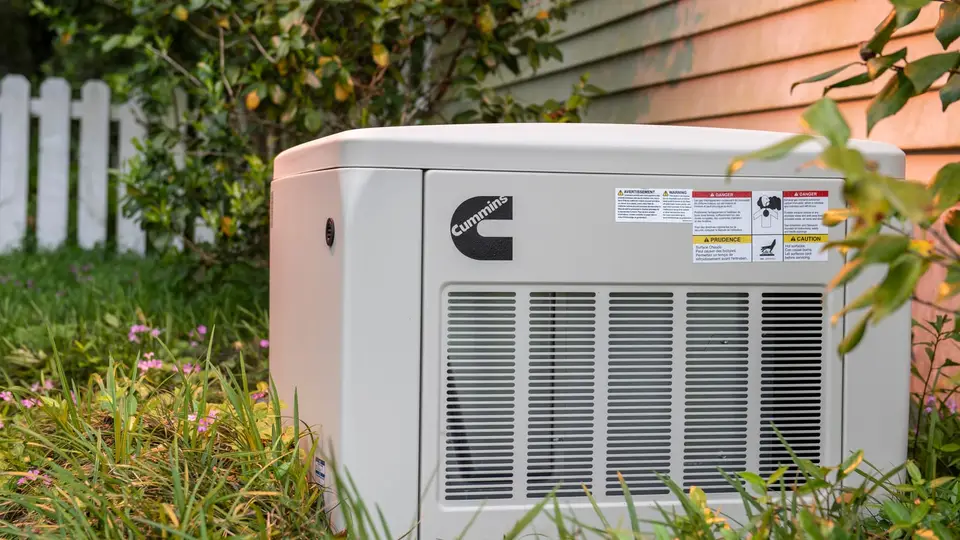
This post came out of a design job in September 2026. A Dallas-Fort Worth homeowner with a grid-tied rooftop solar system asked for a Cummins RS30, a 30kW liquid-cooled whole-home standby generator, with an automatic transfer switch (ATS). The generator is the easy part. The question that decides the design comes up on every solar home: which side of the transfer switch does the solar connect to? Get it wrong and the solar and the generator work against each other during the outage the generator was bought for.
What grid-tied solar does when the power goes out
Most residential solar is grid-tied, or "interactive" in code language. The inverters convert the panels' DC output into AC that matches the utility's voltage and frequency. They are also required to stop when the utility stops. It is the reason a lineman working on a dead line is not hit by power from your roof.
- Inverters certified to UL 1741 and IEEE 1547 have to detect a loss of the grid. A U.S. Department of Energy national laboratory primer on IEEE 1547-2018 says they must "detect the island and go offline within 2 seconds."
- Once the grid comes back, they wait before exporting again. The same primer says this "return-to-service delay is by default set to 5 minutes."
- The National Electrical Code says the same thing from the building side. Section 705.40 (2023 edition) requires a power production source to disconnect automatically when the utility is lost and not reconnect until the utility is restored.
That is why a solar-only home goes dark in an outage even on a bright afternoon. It is working exactly as designed.
What goes wrong when the solar is on the generator side
In many solar homes, the solar connects inside the main panel through a breaker, which the NEC calls a load-side connection (Section 705.12). If a transfer switch is installed ahead of that panel, the solar ends up on the generator side of the switch. In an outage, the sequence runs like this:
- The utility fails. The inverters detect it and go offline within 2 seconds.
- The generator starts and the transfer switch moves the house onto it.
- The inverters now see steady 240-volt, 60-hertz power on their terminals, and to them it looks like the grid came back.
- After their return-to-service delay, they begin exporting again, this time into a system whose only source is your generator.
- Whenever the panels produce more than the house is using, the surplus has nowhere to go but back into the generator. A generator is built to deliver power, not to absorb it.
The manufacturers are blunt about the result. On transfer switches, Cummins writes: "If the solar panels and the generator are not electrically isolated, the AC inverter associated with the solar panels may attempt to feed power back to the generator, creating a hazardous and potentially damaging situation for both the generator and the inverter." Enphase's technical brief on AC coupling of its microinverters is shorter: "Do not connect the Enphase Microinverters to the output of an engine generator. This can cause damage to the microinverters and the generator." It then gives the remedy: "Use a transfer switch to ensure that the generator is always isolated from the Enphase Microinverters."
Solar manufacturers that do support generators do it with dedicated controls. SolarEdge's generator application note, for example, caps solar at 35 percent of generator capacity "to protect the generator(s) and avoid damage." A standard ATS and a standard grid-tied inverter have no such controls between them. The dependable answer is to keep the two apart.
The fix: connect the solar on the utility side of the transfer switch
We move, or design, the solar connection so it lands between the meter and the transfer switch. That is on the utility side of the switch, where the generator can never reach it. Reading from the street to the house, the layout is:
| In order from the street | What it does |
|---|---|
| Utility meter (Oncor, a cooperative or a city utility) | Utility metering only. Nothing of ours connects inside it. |
| Solar disconnect and supply-side connection | The solar joins the utility conductors here, through a visible, lockable, labeled disconnect. |
| Service-entrance rated automatic transfer switch | Serves as the home's main disconnect. It chooses utility or generator, never both. |
| Main panel and house circuits | Fed by whichever source the switch has selected. |
| Cummins RS30 generator | Connects to the switch's generator side only. |
In an outage, the switch opens the utility side and closes onto the generator. The solar is on the utility side, so the switch cuts it off along with the grid. The inverters see a dead utility and stay offline, exactly as the anti-islanding rules intend. The generator carries the house with no second source pushing back at it. When the utility restores power, the switch transfers the house back, the inverters wait out their 5-minute delay, and the solar resumes as normal.
The NEC provides for this connection. Section 705.11 of the 2023 edition allows a power source to connect to a service on the supply side of the service disconnecting means, in accordance with Section 230.82(6). That section requires a disconnect listed as suitable for service equipment, plus proper overcurrent protection. Texas adopted the 2026 NEC as the state electrical code effective September 1, 2026. The section numbers in this post are from the 2023 edition, which several DFW cities still enforce; on a permit inspected to the 2026 edition we check the equivalent sections before we design around them.
What your utility allows at the meter
It would be convenient to make the connection at the meter itself. Whether you can, and what disconnect you need, is set by the utility that owns the meter, not by the city. Oncor delivers power to most Dallas-Fort Worth addresses, and its Electric Service Guidelines (February 2025) are specific:
- Meter sockets "are to be used exclusively for Company metering."
- "Non-utility meter collars or other devices are not allowed to be installed between the utility meter and meter socket or inside the meter socket."
- "A Visible Lockable Labeled AC Disconnect (VLLD) must be located between the Company Meter and all sources of Distributed Generation." It must be within 10 feet of the meter unless special placards are used, and "Molded-case breakers are not considered to be an acceptable VLLD."
- "A customer generator transfer switch is to be installed on the load side of the meter base," and never "integrated or placed in series with the meter and the base."
The NEC defers to the utility here as well. Section 705.11(C)(3) allows connections in equipment under the utility's exclusive control only where the utility approves them (EC&M, NEC requirements for interconnected power sources), and Oncor has said it does not. So the supply-side connection is made downstream of the meter socket in its own enclosure, with the disconnect Oncor requires. Meter-collar generator adapters and solar adapters are off the table in Oncor territory.
Other utilities in the Metroplex publish their own rules, and they are not identical:
| Utility | Solar disconnect | Meter socket |
|---|---|---|
| Oncor | Visible, lockable, labeled; within 10 ft of the meter; molded-case breakers not accepted | Oncor metering only; no collars |
| CoServ Electric | Visible, lockable, labeled; within 10 ft; lockable with a CoServ lock | CoServ metering only |
| TNMP | Visible, lockable, labeled; within 10 ft; molded-case breakers not accepted | Company-approved socket; no bypassing without approval |
| Denton Municipal Electric | Visible-break disconnect within 4 ft of the meter | No generation equipment or wire inside; line-side taps only through junction-box connectors |
| Garland Power & Light | Not published | GP&L seals; solar capped at 10 kW |
| Tri-County Electric Cooperative | Visible load-break disconnect within 6 ft; lockable with a Tri-County lock | Line-side taps not accepted; call before breaking the seal |
| HILCO and Navarro County cooperatives | Visible, lockable disconnect next to the meter | Line-side connection allowed after the meter, with pre-approval |
One of those rows changes the design itself. Tri-County Electric Cooperative, which serves parts of Keller, Southlake, Grapevine, Trophy Club and Haslet, states in its distributed generation checklist that it "does not accept line-side taps." On a Tri-County home, the usual supply-side solar connection is not available, so the way the solar is kept on the utility side of the transfer switch has to be agreed with Tri-County in writing before we quote. Tri-County also requires the transfer switch itself to be UL 1008 listed and within 6 feet of the meter, and does not accept interlock kits or meter-mount transfer switches.
Where a utility does not publish a rule, we get it in writing before the job rather than assume another utility's rule applies. The utility on your electric bill is the one whose rules govern, and territory does not follow city limits. Each of our service area pages lists the utilities serving that city and what each one requires.
The tradeoff: your solar will not run during an outage
This design keeps the solar off while the generator runs. For most homeowners that is the right trade. The generator carries the whole house, and the solar is back the moment the grid is. If you want your solar producing during an outage, that takes a battery system designed for it, and it is a different design. Tesla's guidance on combining Powerwall with a generator, for example, has the "Powerwall system installed between the utility meter and the generator transfer switch." The principle is the same: the solar side stays upstream of the generator's transfer switch. Enphase handles it through its IQ System Controller, which its generator integration brief says "ensures that the generator is never connected to the home when the system is on-grid."
Which transfer switch, and how it is sized
The utility-side solar connection works most cleanly with a service-entrance rated automatic transfer switch, because the switch becomes the home's main disconnect and there is one clear boundary between the utility side and the house side. The switch is sized to the electrical service, not to the generator: a 200-amp service takes a 200-amp switch whether the generator behind it is 20kW or 30kW. Cummins offers service-entrance rated switches in its RA family, and the differences are laid out in the ElectricPros guide to service-entrance transfer switches. The switch also does the job every transfer switch exists for: it keeps the generator from backfeeding the utility lines.
What we check on a solar home before quoting
- Where the solar connects today: a breaker in the main panel, a tap ahead of the main breaker, or a separate disconnect. We inspect it rather than assume.
- The inverter type (microinverters or a string inverter) and the system's size, from the nameplate and the interconnection paperwork.
- Whether the home has a battery, and whether that battery already includes its own transfer device.
- The service size and meter arrangement, which decide the transfer switch rating and where the solar disconnect can go within the utility's distance rule: 10 feet from the meter for Oncor, CoServ and TNMP, 4 feet for Denton Municipal Electric.
- The gas meter and line, because a 30kW liquid-cooled generator is the largest gas appliance most homes will ever have. See how to size a standby generator.
- Who installed the solar. Moving its point of connection touches their work, so we coordinate with them and with your utility rather than surprise either one.
Permits and inspections
A generator, a transfer switch and a solar reconnection are permitted electrical work. Texas Senate Bill 1202 limits what cities may require for residential backup power systems, and we cover what that does and does not change in SB 1202 and generator permits. Utilities have their own generator paperwork too. CoServ and TNMP each require an application for the generator itself and an open-transition transfer switch, and Oncor asks, on its residential project requirements, that when a generator is connected the installer confirm the transfer switch's mode of operation, open or closed transition. We handle the permit, the inspection and the utility coordination.
What it costs
A typical complete 20kW whole-house installation in Dallas-Fort Worth runs $13,500–$17,000 all in. Estimate only. Every installation is different; a site visit is required to determine whether your installation will cost less or more than this estimate. A solar home with a liquid-cooled 30kW unit is quoted in writing after an on-site survey, because the supply-side solar connection, the transfer switch rating and the gas service all depend on what is already on the house. Equipment prices for every Cummins model, the RS30 included, are published at utselectricpros.com. Clements Electric installs Cummins as the electrical contracting arm of UTS ElectricPros, LLC, an authorized Cummins dealer.
Adding a generator to a home with solar?
A master electrician will look at where your solar connects before anything is quoted. Written price after a site survey. Licensed Texas Electrical Contractor TECL #40628.
Generator and solar questions
Yes. The requirement is that the solar connects on the utility side of the generator's automatic transfer switch, between the meter and the switch, so the generator never powers the solar inverters. If the solar currently connects inside the main panel, that connection is usually moved as part of the generator job.
During an outage the inverters see the generator's steady voltage and frequency as the grid returning. After their return-to-service delay, 5 minutes by default under IEEE 1547-2018, they begin exporting. Surplus solar then flows back into the generator. Cummins calls this a hazardous and potentially damaging situation for both the generator and the inverter, and Enphase warns against connecting its microinverters to an engine generator's output.
Not with a standard grid-tied system wired the safe way. The transfer switch isolates the solar along with the utility, so the inverters stay off until the utility restores power. Running solar during an outage takes a battery system designed for it, such as a Tesla Powerwall or an Enphase system with an IQ System Controller.
That depends on the utility, and for the utilities serving most of Dallas-Fort Worth the answer is no. Oncor reserves the meter socket for its own metering and prohibits meter collars and other devices there. CoServ reserves its sockets for CoServ metering, and Denton Municipal Electric bars any generation equipment or wire inside its meter sockets. The supply-side solar connection is made in its own enclosure downstream of the meter, with the disconnect your utility requires: within 10 feet of the meter for Oncor, CoServ and TNMP, and within 4 feet for Denton Municipal Electric.
No. Cummins air-cooled home standby generators top out at the 20kW RS20A. Above that, the Cummins range is liquid-cooled, starting with the RS25 (25kW) and the RS30 (30kW). The 28kW air-cooled home standby unit on the market is made by a different manufacturer.