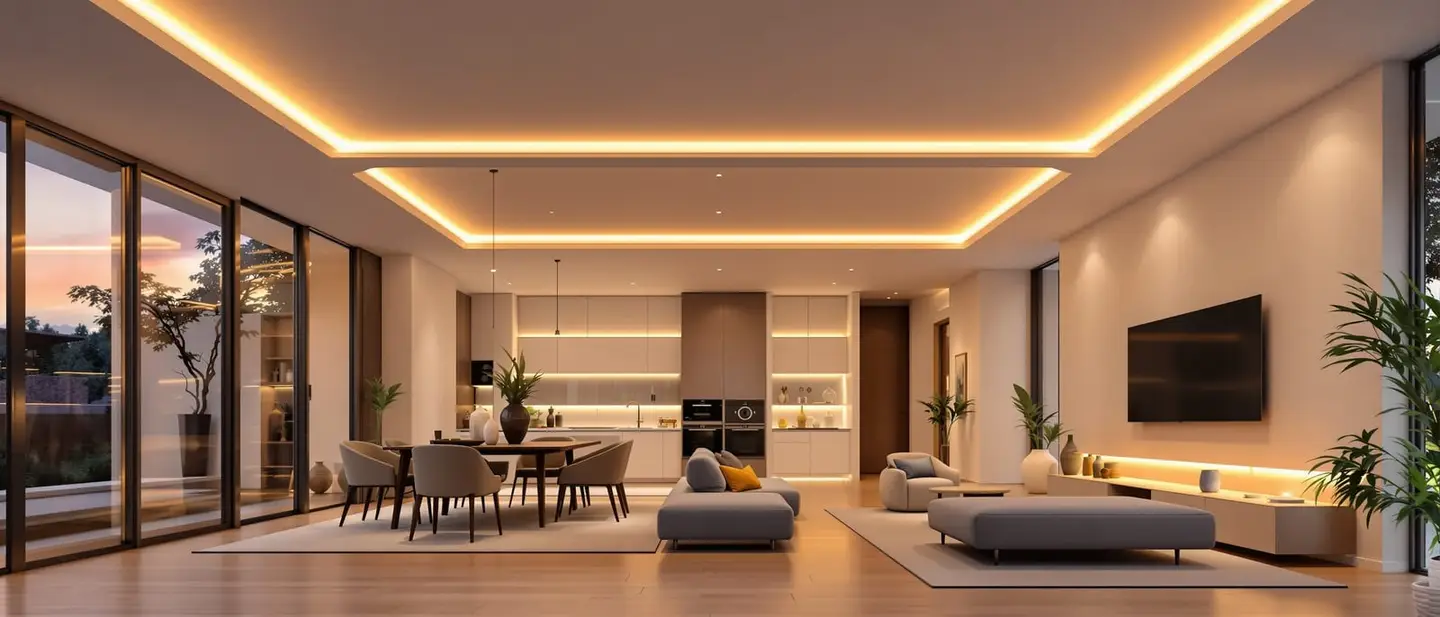
Plan a tenant finish-out's electrical around five things: the city permit path, whether the existing service and panel can carry the load, lighting and controls that meet the energy code, coordination with the landlord and general contractor, and the lead times that set the schedule.
This guide is part of our Commercial & Industrial Electrical service in Dallas–Fort Worth.
Plan a tenant finish-out's electrical around five things: the city permit path, whether the existing service and panel can carry the space's load, lighting and controls that meet the energy code, coordination with the landlord and general contractor, and the lead times that set the schedule. In both Grand Prairie and Arlington, finish-out work needs a permit before it starts, and nobody can occupy the space until the city issues a certificate of occupancy. Clements Electric is based in Grand Prairie and takes commercial jobs over $100,000.
Do I need a permit for a tenant finish-out in Grand Prairie or Arlington?
Yes. Grand Prairie's Commercial Interior Finish Out page states that all interior finish-out and upgrades to an existing building require an approved permit from Building Inspections. The submittal includes a floor plan showing each room and its use, the class of work, and electrical, plumbing and mechanical plans. The city says permits are processed in approximately 5–10 business days after the online application, and longer if the applicant has corrections to make.
Grand Prairie's certificate of occupancy page sets the finish line: no building or suite may be used or occupied until Building Inspections issues a CO, and a new one is needed for a change of occupant or use. For new construction, remodels and additions, the construction permits have to be closed out before the CO application.
Arlington's Permitting and Inspections page adds two items that catch owners out. Commercial and multifamily projects with a construction value over $50,000 must be registered with TDLR's Architectural Barriers program before a permit application goes to a city. For renovation of commercial buildings, the applicant must show proof of an asbestos survey before permits are issued. Arlington's certificate of occupancy page is blunt: "A building or tenant space may not be occupied, and the business may not be operated, until the CO is issued." The accessibility registration is a state requirement, not only an Arlington one: TDLR's Architectural Barriers program requires projects with a total estimated cost of $50,000 or more to be registered, with construction documents reviewed by a Registered Accessibility Specialist.
| Item | Grand Prairie | Arlington |
|---|---|---|
| Permit before finish-out work starts | Required | Required |
| TDLR accessibility registration, projects of $50,000 or more | Required by state law | Before permit application |
| Asbestos survey for commercial renovation | Ask at intake | Before permit |
| Certificate of occupancy before opening | Required | Required |
Which code edition applies is also a plan-review question. TDLR adopted the 2026 NEC as the state electrical code effective September 1, 2026. Grand Prairie's adoption notice records the city adopting the 2023 NEC in December 2023. We confirm the governing edition before drawings are finalized, not after an inspector cites it. For how permits work on the service side, see do I need a permit for a panel upgrade in Texas.
Can the existing panel carry the space? Load letters and capacity
This is the question to answer before the lease is signed, not after the equipment arrives. A shell suite comes with whatever service the landlord allotted to it: a panel of a certain amperage, single-phase or three-phase, at a certain voltage. Whether that is enough depends on what you are putting in the space.
- An equipment list with nameplate voltage, phase and amperage for anything larger than a desktop
- HVAC: the rooftop units or split systems serving the suite, which the landlord may or may not be providing
- Process loads: kitchen equipment, compressors, CNC or production machines, ovens, kilns
- IT and server closets, signage, and any EV charging for staff
- Where you expect to be in three years, because re-feeding a suite later costs more than sizing it now
From that list we run a load calculation under NEC Article 220 and compare it with what the suite actually has. Landlords commonly ask for the result in writing, usually called a load letter, to confirm the building can carry the tenant. If it cannot, there are three paths: rebalance within the building's existing capacity, upgrade the suite's feeder and panel, or increase the service. That last one brings Oncor, the delivery utility across most of Grand Prairie and Arlington, into the schedule.
Production spaces make this sharper. Our work wiring all machines through Send-Cut-Send's multi-phase expansion in Grand Prairie and Arlington was driven by equipment delivery and commissioning dates, and the electrical could not be the reason a machine sat idle.
What does the energy code expect from lighting and controls?
Texas's State Energy Conservation Office lists the 2015 International Energy Conservation Code as the commercial energy code, effective November 1, 2016. Cities can differ, so confirm at plan review. Under the 2015 IECC's mandatory lighting controls, Section C405.2, as laid out in Eaton's IECC 2015 quick reference guide:
- Occupancy sensors are required in spaces including private offices, conference and meeting rooms, break rooms, restrooms, storage rooms, janitorial closets, locker rooms, enclosed spaces of 300 square feet or less, and warehouses, with automatic off within 30 minutes
- In warehouses, occupant sensors must automatically reduce lighting power by more than 50% when unoccupied
- Where occupancy sensors are not used, time-switch controls with a manual override are required
- Daylight-responsive controls apply to spaces with more than 150 watts of general lighting in sidelit or toplit zones
- Section C408.3 requires evidence that the lighting control system has been functionally tested
The practical point: price the controls with the fixtures from the start. Controls that show up as a change order after plan review are how finish-out budgets drift.
Who does what: landlord, general contractor and electrician
The lease work letter decides whose money pays for what, and electrical is where the lines get blurry. Ask the landlord, in writing:
- What electrical capacity is allocated to the suite, and where the panel and meter are
- Whether the shell includes house lighting, HVAC circuits and a fire alarm connection, or whether those are tenant work
- Building standards for fixtures, controls and devices
- Rules for noisy or after-hours work, roof access and shutdowns that affect other tenants
- Who holds the building permit, and whether the electrical permit is separate
With a general contractor running the job, the electrical has to land in the right order against framing, ceiling grid, HVAC and fire protection, with rough-in inspected before walls and ceilings close. We work either way, as the GC's electrical subcontractor or directly for the owner when the scope is mostly electrical.
What sets the timeline?
| Factor | Where it bites |
|---|---|
| TDLR accessibility registration ($50,000 or more) | Before permit application |
| Asbestos survey (Arlington commercial renovation) | Before permit issues |
| City plan review and corrections | Before work starts |
| Long-lead gear: panels, switchgear, transformers | Order at award |
| Service increase or new meter | Oncor coordination |
| Rough-in and final inspections, permit close-out | Before the CO |
| Certificate of occupancy | Before opening |
The delays worth planning out are sequencing problems rather than electrical difficulty: gear ordered after the permit rather than at award, a capacity question raised after the lease rather than before, or controls missing from the original drawings.
What if the building is occupied or the plant is running?
Then the work is planned around the operation. We phase outages so only part of a facility is affected at a time, coordinate utility disconnects in advance rather than on the day, put the outage plan in writing before work starts, and work nights and weekends where production or occupancy requires it. Property managers with older buildings will recognize the same approach from our piece on aluminum wiring and undersized panels in multifamily buildings.
Clements Electric has been a licensed Texas electrical contractor since 1982: TECL #40628, Master Electrician #214180. You can confirm the license through TDLR's license search. Commercial work is priced from drawings or a site walk, with a written scope and a firm number. There is no published price for finish-out because no two suites are the same. See the commercial and industrial electrical page for the rest of our scope.
Have a finish-out in Grand Prairie or Arlington to price?
Send the drawings or ask for a site walk. Written scope and a firm number. Licensed Texas Electrical Contractor TECL #40628.
Tenant finish-out electrical questions
Yes. The City of Grand Prairie requires an approved permit for all interior finish-out and upgrades to an existing building. The submittal includes a floor plan and electrical, plumbing and mechanical plans, and the city says processing takes about 5–10 business days after the online application. No suite can be occupied until the city issues a certificate of occupancy.
A load letter is a written statement of the electrical load a tenant's space will need, based on a load calculation under NEC Article 220 using the equipment list, HVAC and lighting. Landlords use it to confirm the building's service can carry the tenant. If it cannot, the options are rebalancing within existing capacity, upgrading the suite's feeder and panel, or increasing the service with the utility.
Texas's State Energy Conservation Office lists the 2015 IECC as the commercial energy code. Its Section C405.2 requires occupancy sensors in spaces such as private offices, break rooms, restrooms, storage rooms and warehouses, time-switch controls where sensors are not used, and daylight-responsive controls where general lighting in daylit zones exceeds 150 watts. Local adoption can differ, so confirm at plan review.
Usually sequencing rather than the electrical itself: TDLR accessibility registration for projects of $50,000 or more, asbestos surveys for commercial renovations in Arlington, plan review corrections, long-lead panels or switchgear ordered late, utility coordination when the service must increase, and inspections and permit close-out before the certificate of occupancy.
Yes. Clements Electric is a licensed Texas electrical contractor (TECL #40628) based in Grand Prairie, takes commercial jobs over $100,000, and has wired production machines through a multi-phase expansion in Grand Prairie and Arlington. Work is priced from drawings or a site walk with a written scope and a firm number.