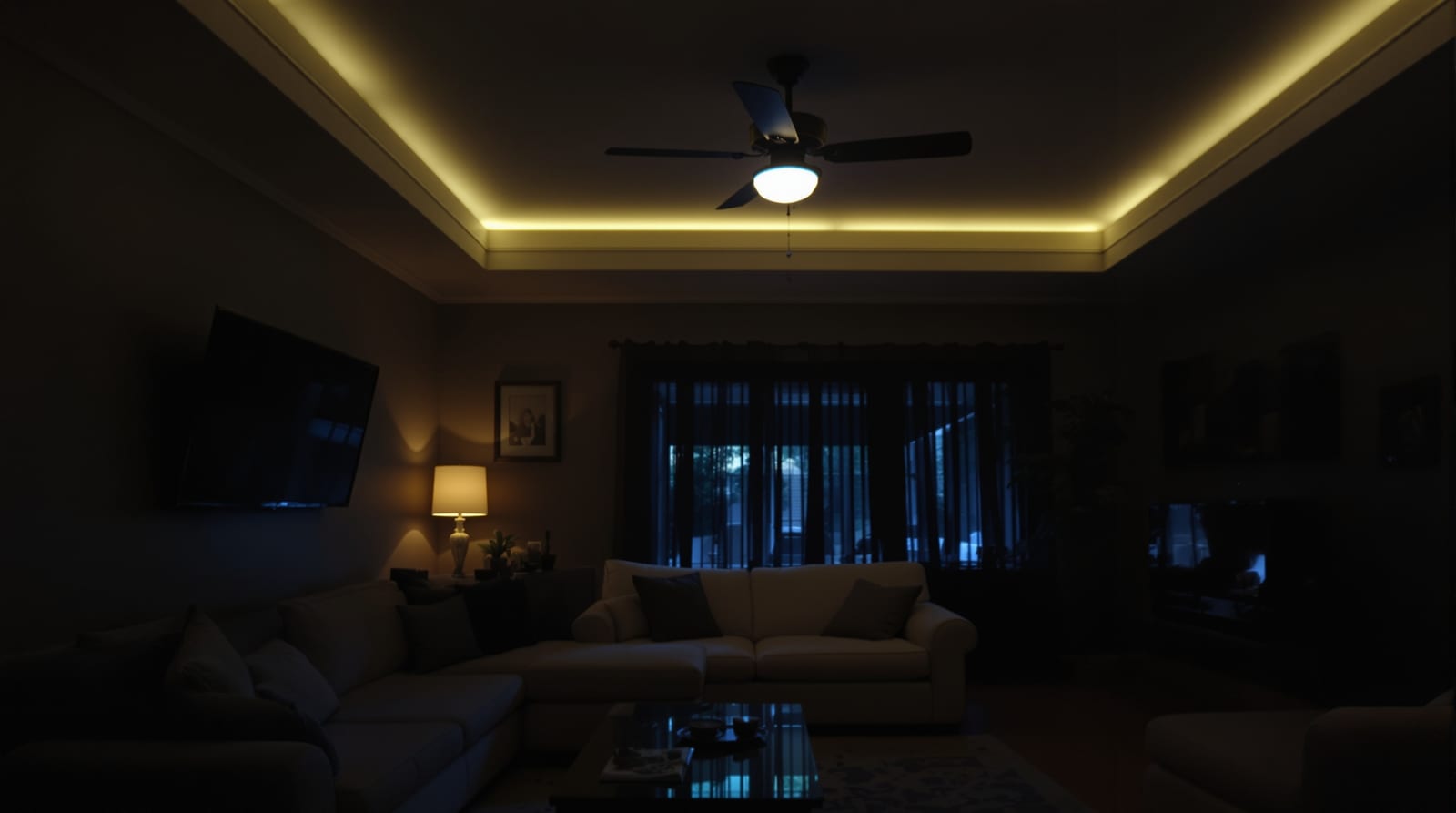
A single flickering light is usually a loose bulb, an LED on an old dimmer, or a loose connection at the switch or socket. Flicker on several circuits at once, or lights that get brighter, points to the panel, the neutral or the utility service and needs an electrician the same day.
This guide is part of our Electrical Repair service in Dallas–Fort Worth.
If one light flickers, the cause is usually at that light: a loose bulb, an LED on a dimmer built for incandescent bulbs, or a loose connection at the switch or socket. If lights flicker on several circuits at once, or some lights get brighter while others dim, the problem is upstream, at the panel, the neutral or the utility service, and it needs an electrician the same day.
Is it one light or the whole house?
That is the first question we ask on the phone, because it splits the causes in two. Check whether the flicker follows one fixture, one room, or the whole house, and whether it lines up with something starting, such as the air conditioner, a dryer or a microwave.
Causes you can check yourself
A loose bulb
Turn the switch off, let the bulb cool, and tighten it. LED bulbs flicker or strobe when the base is not making firm contact in the socket.
An LED bulb on an old dimmer
Dimmers made for incandescent bulbs often make LEDs flicker, buzz or drop out at low settings. The fix is an LED-rated dimmer, such as Lutron's C·L line or Leviton's LED-rated dimmers, and a bulb marked dimmable. If the bulb is not marked dimmable, no dimmer will fix it.
A lamp that flickers in one outlet
Try the lamp in another outlet. If it only flickers in one, the outlet probably has a loose or worn connection. That can heat up and arc, so stop using the outlet and have it replaced. Do not open the box unless you can confirm the power is off at the breaker with a tester.
Causes that need an electrician
Lights dim when a big appliance starts
A brief dip when the AC compressor or a vacuum starts is common, because motors draw a burst of current at startup. A dip that is deep, lasts, or keeps getting worse means the circuit or the service is carrying more than it should, or there is a loose connection somewhere between the meter and the light. Our breaker tripping guide covers overloaded circuits in more detail.
Flicker on several circuits at once
When the flicker shows up in different rooms on different breakers, look at what those circuits share: the panel, the main breaker, the service conductors and the neutral. A loose main lug or a failing main breaker produces heat at the connection. Treat house-wide flicker as same-day work, and if you smell burning or the panel is warm, follow our burning smell guide.
Lights that get brighter
If some lights get brighter while others dim, especially when a large load turns on, suspect a loose or broken neutral. Without a solid neutral, the voltage between the two halves of a 120/240-volt service stops being balanced, and some circuits can see well above 120 volts. That damages electronics and appliances quickly. Turn off the main breaker if you can do it safely and call us. If the problem is on the utility side, Oncor will need to repair it.
An old Federal Pacific or Zinsco panel
Flicker does not prove a panel is failing, but in a Federal Pacific or Zinsco panel we check the panel first. The Consumer Product Safety Commission's own testing found Federal Pacific Stab-Lok breakers "fail certain UL calibration test requirements" (CPSC, 1983). Our posts on whether every Federal Pacific panel needs replacing and Zinsco panels cover what to do.
A problem on the utility side
If your neighbors see the same flicker, the cause may be the utility's equipment rather than your house. In Oncor territory you can report it at 1-888-313-4747 (Town of Addison, Report a Power Outage). Not sure who your utility is? See which electric company serves your address.
When flickering means turn the power off
Flicker with any of these signs is an emergency. Turn off the affected breaker, or the main if the problem is house-wide, and call:
- A burning or hot-plastic smell near the panel, an outlet or a switch
- Outlets or switch plates that are discolored or warm
- Buzzing or crackling from the panel or a wall
- A breaker that trips again as soon as you reset it
- Smoke or sparks from any device or outlet
- Lights that get brighter rather than dimmer
Smoke or flame is a 911 call first. Our emergency electrician guide explains what can wait until morning and what cannot.
What a flickering-light service call costs
Troubleshooting starts at $240, the same as any electrical repair diagnostic, and the $240 is credited toward the repair if you go ahead. You get a flat-rate written quote before any repair starts, and simple fixes such as replacing an outlet or a dimmer are often done on the same visit when we have the parts. We offer same-day service Monday through Friday.
Ready to get started?
Frequently Asked Questions
Yes, when the cause is a loose neutral or a loose connection at the panel, because the voltage reaching your devices swings. A whole-house surge protector does not fix that. The connection has to be repaired.
LED bulbs run on small electronic drivers, and many react to dimmers and small voltage changes that an incandescent filament would hide. Start with an LED-rated dimmer and a bulb marked dimmable. If LEDs flicker on several circuits, have the panel and neutral checked.
Only if the panel is the cause. We find the cause first. If it is a worn Federal Pacific or Zinsco panel, or a panel without the capacity for the house, a 100-amp to 200-amp replacement typically runs $2,200–$4,800 all in, quoted in writing after an on-site load calculation. See panel upgrades.
Summer adds load. Air conditioners and pool pumps run for hours and start repeatedly, which shows up a weak connection or an overloaded circuit that was already there. The heat does not cause it; the load exposes it.